SATA vs NVMe: Why Your SSD Choice Actually Matters
2 MIN READ · JUL 1, 2026
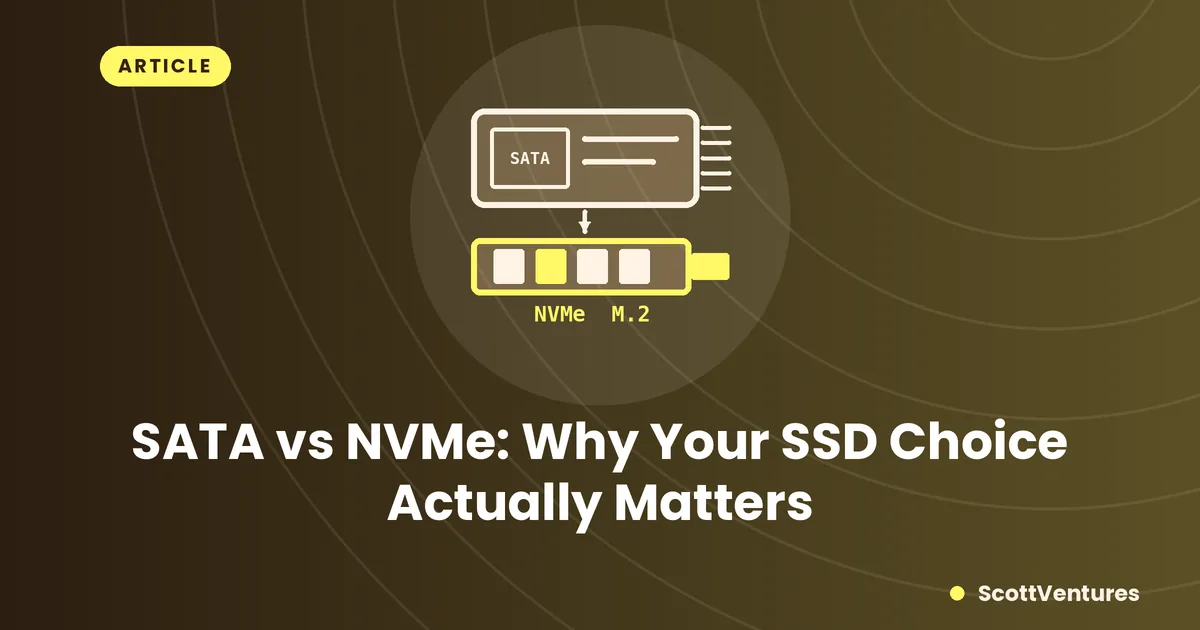
Both are solid-state drives — no spinning platters, no moving parts. The difference that actually matters is how they connect to the rest of your system, and it's a bigger gap than the name suggests.
SATA: built for hard drives, reused for SSDs
SATA is an older interface, originally designed for spinning hard drives. When SSDs came along, they adopted the same connector for compatibility — but that means SATA SSDs are bottlenecked by a standard that predates flash storage. SATA III, the version in nearly every modern drive, caps out around 600 MB/s, regardless of how fast the SSD inside is actually capable of going.
NVMe: designed for flash from the start
NVMe (Non-Volatile Memory Express) isn't a physical connector — it's a protocol built specifically for solid-state storage, typically running over an M.2 slot directly on the motherboard, communicating over PCIe lanes instead of the older SATA bus. That difference alone unlocks speeds of 3,500 MB/s and up, several times faster than SATA's ceiling.
Why the gap is so large: SATA was designed around the mechanical limits of spinning platters. NVMe skips that legacy entirely and talks to the CPU almost directly through PCIe — the bottleneck moves from the interface to the drive itself.
Does the speed actually matter?
For everyday use — web browsing, office work, general responsiveness — the jump from a SATA SSD to NVMe is barely noticeable, since neither is the bottleneck for those tasks. Where it matters is large sequential transfers: loading big game worlds, exporting large video files, or moving large datasets around. If your workload involves those regularly, NVMe is a real, felt upgrade. If it doesn't, a SATA SSD is still miles ahead of a spinning hard drive and often the better value.
Checking what your motherboard supports
Not every M.2 slot runs NVMe — some are wired for SATA-speed M.2 drives instead, which look identical but perform like a standard SATA SSD. Check your motherboard's manual for which M.2 slots support NVMe/PCIe before buying, since plugging an NVMe drive into a SATA-only M.2 slot won't unlock its real speed.
Comments