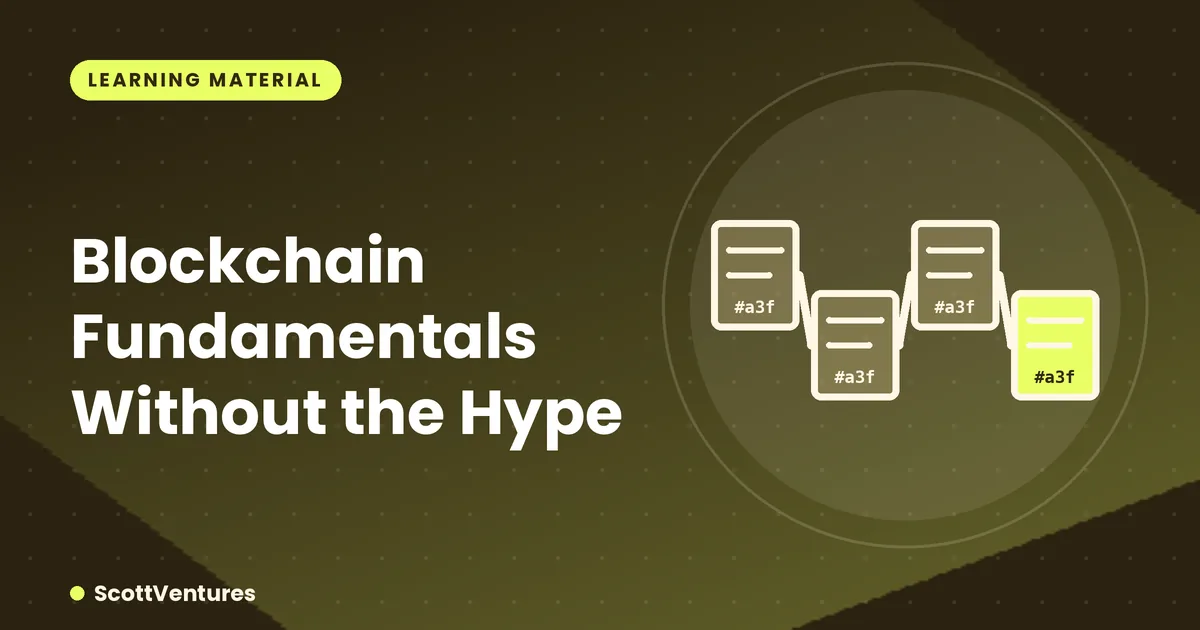
The core idea: a chain of linked, tamper-evident records
A blockchain is a list of records ("blocks"), each containing a cryptographic hash of the previous block. Change anything in an earlier block, and its hash changes — which breaks the link to every block after it, since each one recorded the old hash. This is what makes tampering with history detectable rather than merely difficult.
Block 1: data + hash(genesis)         → hash_1
Block 2: data + hash_1                → hash_2
Block 3: data + hash_2                → hash_3
Decentralization: no single party holds the only copy
Instead of one central database controlled by one organization, a blockchain's ledger is replicated across many independent participants (nodes), each verifying new blocks against the same rules. For a change to be accepted, it has to be consistent with what the majority of honest nodes agree on — there's no single point that can unilaterally rewrite history.
Consensus: how independent nodes agree on the truth
With no central authority, a blockchain needs a mechanism for nodes to agree on which transactions are valid and in what order:
- Proof of Work — nodes compete to solve a computationally expensive puzzle; the winner adds the next block, at real energy cost, which is what makes attacking the chain expensive
- Proof of Stake — nodes are chosen to validate blocks roughly in proportion to how much cryptocurrency they've locked up as collateral, with dishonest behavior costing them that stake
Both mechanisms exist to answer the same underlying problem: make dishonesty economically irrational, without needing a trusted central party to enforce honesty directly.
Smart contracts: code that runs on the chain itself
// Simplified Solidity example
function transfer(address to, uint amount) public {
    require(balances[msg.sender] >= amount);
    balances[msg.sender] -= amount;
    balances[to] += amount;
}
A smart contract is program code stored and executed on the blockchain itself — its results are just as tamper-evident as any other data on the chain, and it runs exactly as written, with no party able to alter the outcome after the fact.
Blockchain is a specific tool for a specific problem. It's genuinely useful when you need a tamper-evident, shared record among parties who don't fully trust each other and don't want a single central authority. For most applications — where a trusted party already exists and a regular database is faster, cheaper, and simpler — a blockchain solves a problem you don't actually have.
Separating the technology from the speculation
Cryptocurrency price volatility and speculation are a separate topic from the underlying technology — a blockchain's properties (tamper-evidence, decentralization, transparency) are worth understanding on their own mechanical terms, independent of any particular coin's market behavior.
Comments