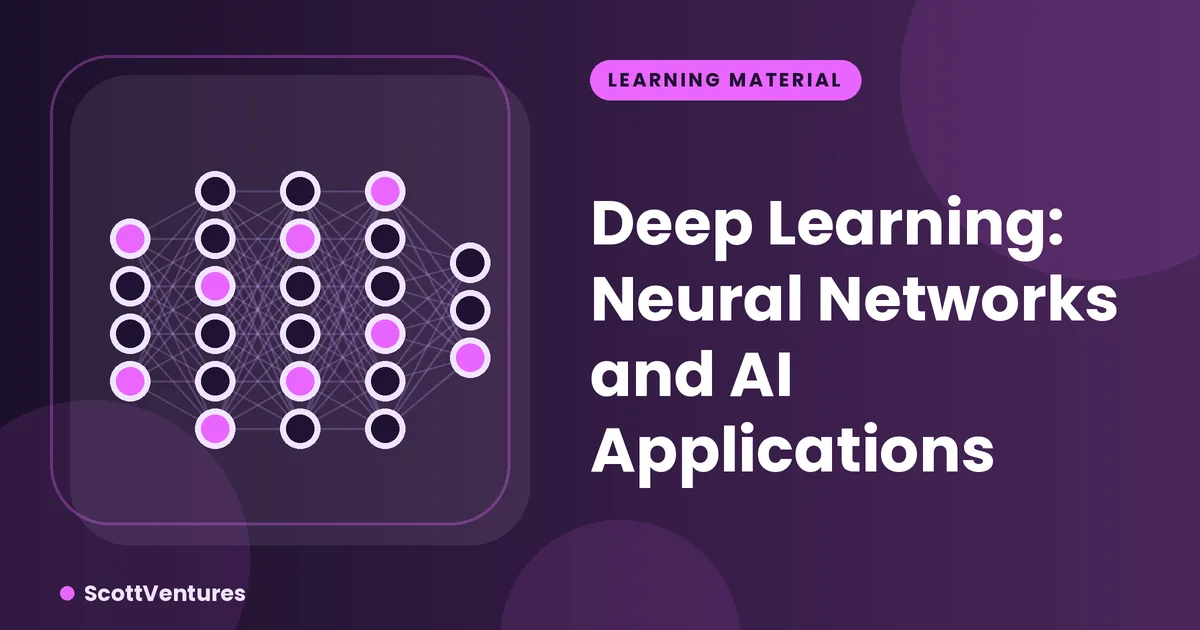
Neural networks, without the mysticism
A neural network is a chain of simple math operations: multiply inputs by weights, add a bias, pass the result through a nonlinear function, repeat. Nothing in that description is intelligent on its own — what makes it useful is that the weights can be adjusted automatically so the output gets closer to what you wanted, across millions of examples. "Deep" just means there are multiple layers of this stacked on top of each other.
What a layer actually computes
For a single layer, each output is a weighted sum of every input, plus a bias, passed through an activation function:
output = activation(W · input + b)W (weights) and b (bias) are the numbers the network learns. The activation function — commonly ReLU, which is just max(0, x) — is what lets the network model non-linear relationships. Without it, stacking layers would collapse into one big linear equation, no matter how many layers you added.
How learning actually happens
Training a network means running an example through, checking how wrong the output was (the "loss"), and then using calculus — specifically the chain rule, applied layer by layer, called backpropagation — to figure out how much each weight contributed to that error. Each weight gets nudged slightly in the direction that would have reduced the error. Do this millions of times across a large dataset, and the weights converge toward values that generalize to new, unseen inputs.
Convolutional networks: built for images
A plain fully-connected layer treats every pixel as unrelated to its neighbors, which throws away the fact that images have spatial structure. A convolutional layer instead slides a small filter across the image, looking for the same pattern (an edge, a curve, eventually a shape) regardless of where it appears. Stack enough of these, and early layers detect edges, middle layers detect shapes, and later layers detect whole objects.
Recurrent networks and the sequence problem
Images are fixed-size grids; language and audio are sequences where order matters and length varies. Recurrent networks (and their more capable descendant, the Transformer architecture behind most modern language models) are built to carry information forward across a sequence, so "the bank of the river" and "the bank on Main Street" can be told apart using the words around them.
Overfitting: the problem you'll hit first
A network with enough capacity can simply memorize your training data instead of learning general patterns — it'll look perfect on paper and fail on anything new. The standard defenses: hold out a validation set you never train on, watch for the point where validation performance stops improving while training performance keeps climbing, and use regularization techniques (dropout, weight decay) that discourage the network from relying too heavily on any single pathway.
Where to actually start
Skip building a network from scratch in raw math as a first project — it teaches the theory but burns time on plumbing. Start with a high-level framework (PyTorch is the current default for learning) and a small, well-understood dataset like MNIST digit classification. Get something working end to end first; the intuition for why it works deepens once you have a working baseline to experiment on top of.
Comments