What "learning" actually means here
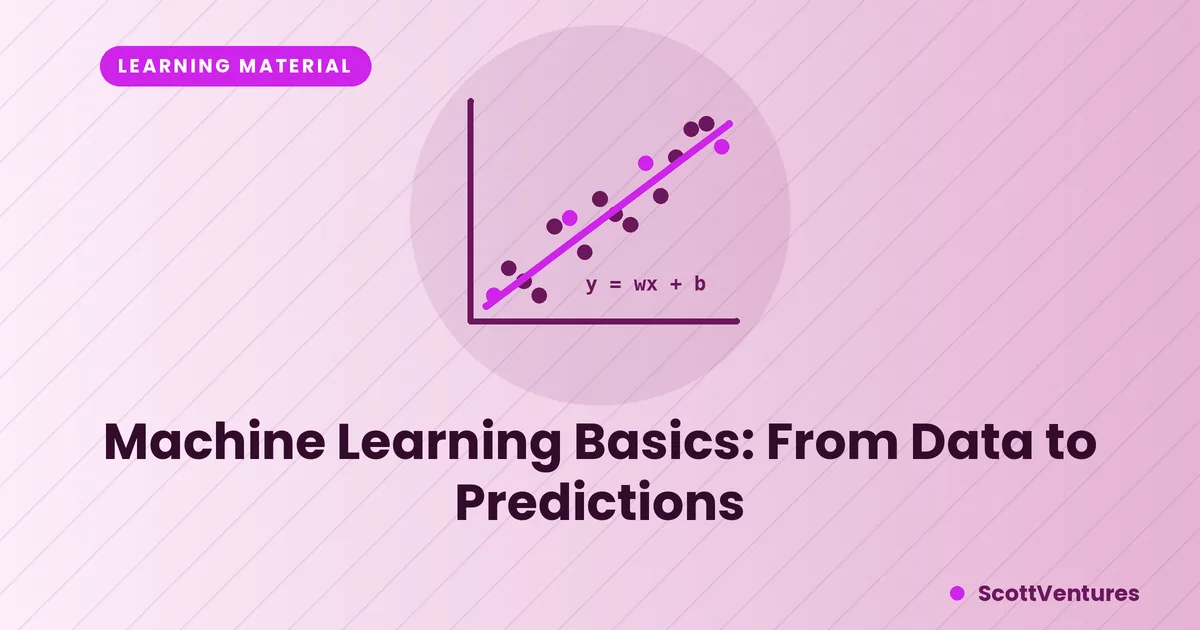
A machine learning model doesn't reason the way a person does — it finds a mathematical function that maps input data to output predictions, by adjusting internal numbers (weights) until its predictions on known examples get as close as possible to the correct answers.
Supervised learning: learning from labeled examples
Most practical ML starts here: you give the model many examples, each paired with the correct answer (a "label"), and it learns the pattern connecting them.
- Classification — predicting a category (spam or not spam, cat or dog)
- Regression — predicting a number (a house price, tomorrow's temperature)
A spam filter trained on thousands of emails labeled "spam" or "not spam" is a classification problem; predicting a house's sale price from its size and location is regression.
Features: what the model actually sees
A feature is one measurable input the model uses — square footage, number of bedrooms, distance to downtown, for a house price model. Choosing and preparing good features (feature engineering) often matters more to a model's accuracy than which algorithm you pick.
Training, validation, and test sets
Full dataset
  ├── Training set (≈70%)   — the model learns from this
  ├── Validation set (≈15%) — used to tune settings during development
  └── Test set (≈15%)       — touched only once, at the very end
Splitting data this way exists to answer one honest question: does the model actually generalize to data it's never seen, or has it just memorized the examples it was trained on?
Overfitting: memorizing instead of learning
A model that performs great on training data but poorly on new data has overfit — it learned the noise and quirks specific to that training set rather than the underlying pattern. It's the single most common failure mode in practical machine learning, and most techniques (more data, simpler models, regularization, early stopping) exist specifically to fight it.
A simple example: linear regression
from sklearn.linear_model import LinearRegression

model = LinearRegression()
model.fit(X_train, y_train)  # learn from training data
predictions = model.predict(X_test)  # apply to unseen data
Even the simplest ML models follow this exact shape: fit on known data, predict on new data. Deep learning and more sophisticated algorithms add complexity to how the fitting happens internally, but the fit/predict pattern above stays the same.
Where to go from here
Decision trees, random forests, and gradient boosting handle a huge share of real-world tabular data problems with far less tuning than neural networks require — they're worth learning before jumping straight to deep learning, which shines mainly on images, text, and audio.
Comments